
Understanding federal tax brackets and how they work is key for effective financial planning, especially as you navigate your income, tax credits and deductions, and potential tax strategies.
So, let’s look at income tax brackets and marginal tax rates for 2025, and 2026 (beginning with some basics and key points.
What are tax brackets?
Tax brackets are the ranges of income taxed at specific rates.
There are seven federal tax rates: 10%, 12%, 22%, 24%, 32%, 35%, and 37%.
It's important to note that these rates generally don't change unless Congress passes major tax legislation. (That happened with the 2017 Tax Cuts and Jobs Act (TCJA, also known as the "Trump tax cuts.")
Note: In his second term as President, Donald Trump signed the so-called "big beautiful bill" into law on July 4, 2025. However, that legislation doesn't change the tax rates from the TCJA.
However, the tax brackets tied to the rates change yearly since they are adjusted for inflation.
These rates apply to your taxable income, which is your total income minus deductions and credits.
That means only the portion of your income that falls into each bracket is taxed at the rate applicable to that bracket.
Key Points
Marginal Rates: Your tax bracket represents the highest rate you'll pay on any portion of your income, not your entire income.
Inflation Adjustments: The income ranges for each bracket are adjusted annually for inflation, potentially moving you into a different bracket even if your income stays the same.
Filing Status: Your tax bracket depends on your filing status (single, married, filing jointly, etc.), and each status has different income ranges.
So, with all of that in mind, here are the 2025 tax brackets (applicable for returns youll file soon). The IRS also released the 2026 tax brackets, which wapply to returns typically filed in 2027.)
Further below, we consider some examples of how income tax brackets and marginal tax rates work.
IRS 2025 tax brackets
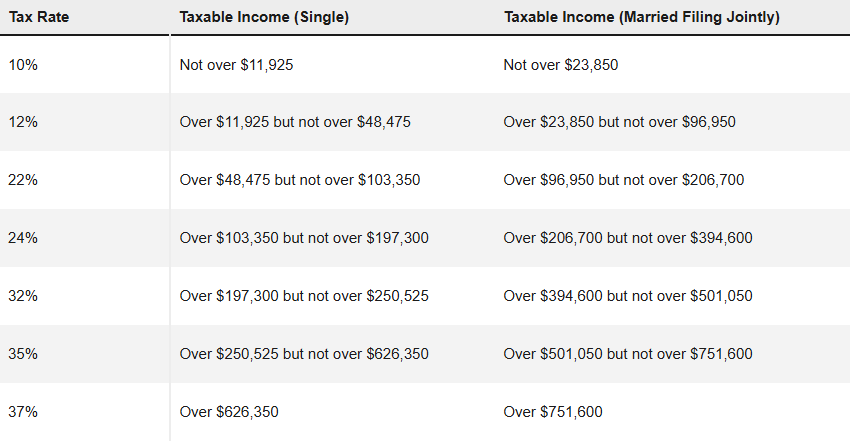
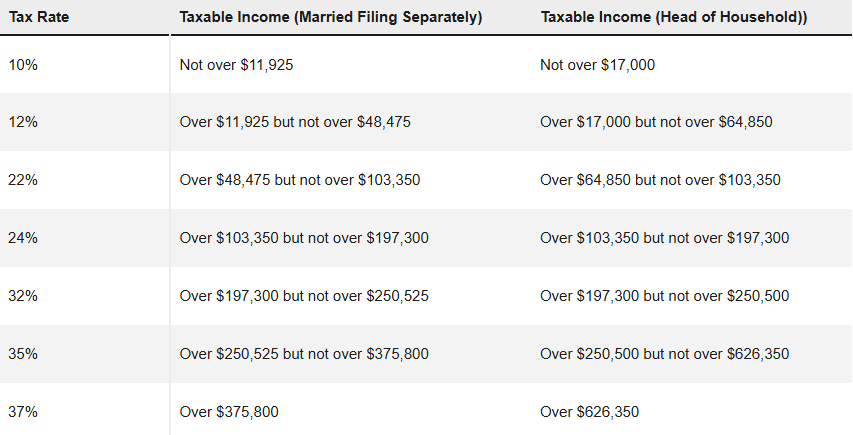
Here are the inflation-adjusted tax brackets for 2025. (Note: These brackets apply to federal income tax returns typically filed in early 2026.)
It's also essential to remember that the associated tax rates remain the same (currently 10%, 12%, 22%, 24%, 32%, 35%, and 37%).
2025 Tax Brackets: Single Filers and Married Couples Filing Jointly
2025 Tax Brackets: Married Couples Filing Separately and Head of Household Filers
New 2026 Tax Brackets
What are the new tax brackets for 2026?
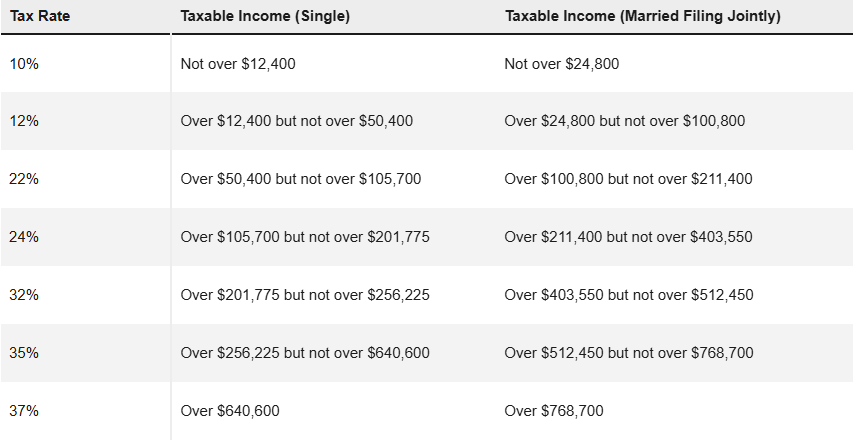
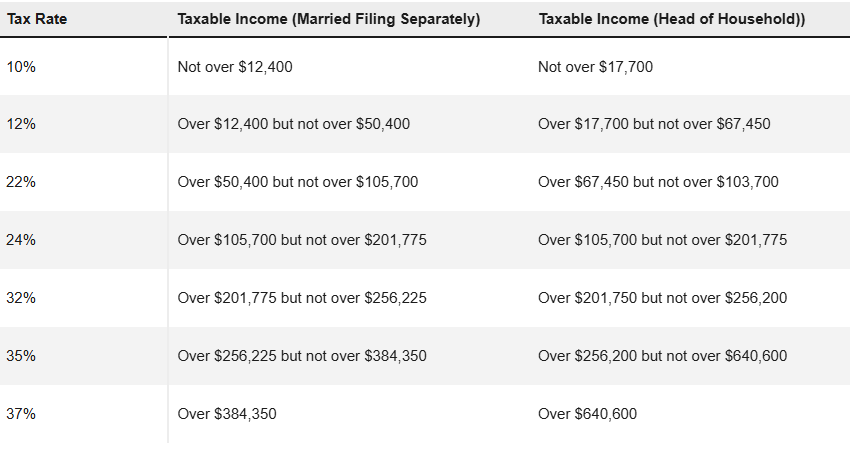
If you're tax planning since we're through the early part of the year, here are the IRS 2026 tax brackets. You'll use these numbers for tax returns typically filed in early 2027.
2026 Tax Brackets: Single Filers and Married Couples Filing Jointly
2026 Tax Brackets: Married Couples Filing Separately and Head of Household Filers
Understanding How Marginal Tax Rates Work
What are the marginal tax rates?
Now that you've seen the tax brackets, let's delve into some examples to show how the brackets and income tax rates work.
Suppose your filing status is single, and you had $100,000 taxable income last year. You may think that since $100,000 falls into the 22% federal bracket, your tax would be a flat $22,000. But thankfully, that’s not the case.
Instead, your $100,000 will be taxed at a marginal tax rate so that only some of your income is taxed at the maximum rate for your income that year (22%). The rest of your income is taxed at the federal income rates below 24%, i.e., 10% and 12%.
Here’s how the marginal tax rate works with this example:
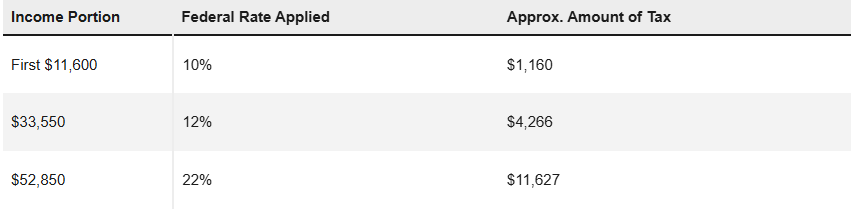
- The first $11,600 of your income is taxed at the 10% rate.
- The next $35,550 of your income (i.e., the amount from $11,601 to $47,150, which will make sense when you see the tax brackets below) is taxed at the 12% federal rate.
- The following $52,850 of your income (from $47,151 to $100,000) is taxed at the 22% federal tax rate.
- That leaves $4,627 of your taxable income (the amount over $95,373) that is taxed at the 24% rate for your federal tax bracket.
Given marginal tax rates, the estimated total federal tax on your $100,000 of taxable income would be about $17,053. That is about $4,946 less than if a flat 22% federal tax rate applied to your entire $100,000 of income.
Remember: We're talking about federal tax. State tax rates and amounts due, if any, will vary. The chart below shows estimates of how much of your income would be taxed at each rate.
Total Estimated Tax: $17,053
Take another example of someone single with a taxable income for the 2025 tax year of $40,000. You might think your tax would be $4,800 since $40,000 falls into the 12% federal bracket. But that’s not the case.
Instead, your $40,000 will get taxed at a marginal tax rate, so only some of your income is taxed at the maximum tax rate for your income that year (12%). The rest of your income gets taxed at the federal income rate below 12%, i.e.,10%.
Here’s how the marginal tax rate works with this example:
- The first $11,600 of your income is taxed at the 10% tax rate.
- The next $28,400 of your income (i.e., the income between $11,601 to $40,000, which will make sense when you see the tax brackets below) gets taxed at the 12% federal rate.

The total estimated federal tax of $4,568 is still a bit ($232) lower than the $4,800 you would be taxed if a flat 12% federal rate applied to your $40,000 of income.
The chart above shows estimates of how much of your income would be taxed at each rate.
Note: We're talking about federal tax. State tax rates and amounts due, if any, will vary.
Total Estimated Tax: $4,568
Marginal vs. effective tax rate: What's the difference?
It's important to know that the marginal tax rate and your effective tax rate differ. As mentioned, the marginal tax rate is the percentage of tax applied to the next dollar of income.
On the other hand, the effective tax rate is the overall percentage of income an individual pays in taxes after considering all deductions, exemptions, and credits.
To calculate your effective tax rate, divide the total taxes paid by the total taxable income. For example, if an individual earned $50,000 and paid $7,000 in taxes, their effective tax rate would be 14% ($7,000 / $50,000 = 0.14 or 14%).
If you have any questions about your tax liability, it's always a good idea to seek advice from a qualified tax professional or financial advisor.
Trump tax bill changes
2025 Trump tax bill tax cuts
There had been a lot of interest in what might happen with tax brackets and federal income tax rates after 2025. That was due to the scheduled expiration of several key tax provisions in the TCJA at the end of this year.
Now that Trump and the GOP have enacted a new tax and spending megabill, many of the TCJA's provisions, including the overall lower tax rates, have been made permanent. (Though in the context of tax law, "permanent" often means the rates have been extended indefinitely, not that a future Congress can never change them.)
GOP lawmakers used the budget reconciliation process, which requires only a simple majority in the U.S. Senate, to pass legislation along party lines to address tax cuts, energy, and the border.
Key tax aspects of the new tax bill include making individual tax cuts permanent, maintaining the lower corporate tax rate, expanding certain business deductions, and temporarily increasing the cap on state and local tax deductions (SALT).